For years, the home cinema debate has been a binary choice: the infinite blacks of OLED or the blinding brightness of Mini LED. Sony is now attempting to shatter that status quo with a third path that could redefine flagship television standards.
Revealed during an exclusive look at Sony’s Tokyo headquarters, the new “True RGB” Mini LED technology is more than just a marketing buzzword. According to recent reports from Gamereactor and What Hi-Fi?, it represents a fundamental shift in how light is created behind your screen, offering what may be the most color-accurate HDR experience ever seen in a consumer living room.
The End of the “White Light” Compromise
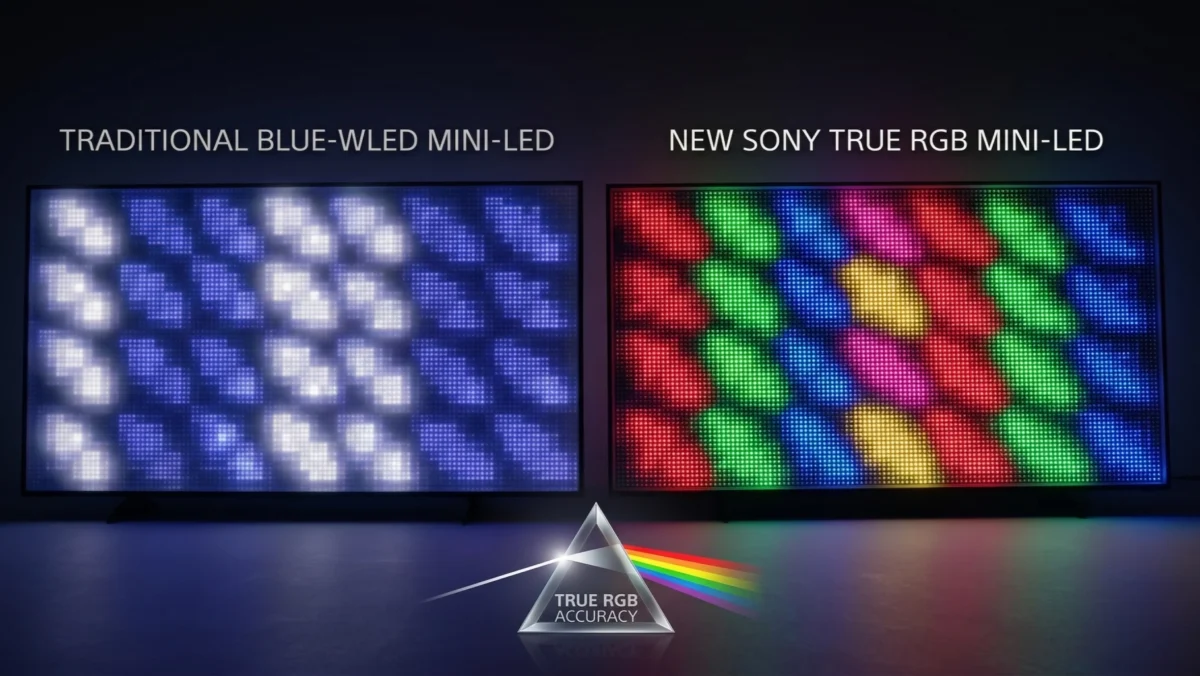
Traditional Mini LED TVs—including Sony’s own highly-rated Bravia 9—rely on blue LEDs coated with phosphorus or filtered through Quantum Dots to create white light. That light is then filtered again by the LCD layer to create color.
True RGB changes the game by going back to basics:
- Pure Primary Backlighting: Instead of “faking” white light, Sony uses individual Red, Green, and Blue diodes in the backlight itself.
- Reference Grade Processing: The tech borrows algorithms directly from Sony’s $30,000 BVM-HX3110 professional mastering monitors, as noted in Business Insider’s hands-on.
- No More “White” Blooming: In traditional sets, a bright red object might have a distracting white “halo” (blooming). With True RGB, the halo is the same color as the object, making it virtually invisible to the human eye.
Why This Matters for Your Living Room
While rivals like Hisense and TCL have experimented with RGB backlighting, Sony’s implementation focuses on precision over raw power. By controlling the intensity of each colored diode individually, the “True RGB” system achieves a “color volume” that was previously thought impossible for LCD-based screens.
| Feature | Standard Mini LED | Sony “True RGB” |
| Backlight Source | Blue LEDs + Filters | Pure Red, Green, & Blue LEDs |
| Color Volume | High | Industry-Leading |
| Blooming | Noticeable (White) | Minimal (Color-Matched) |
| Peak Brightness | ~2,500-3,000 Nits | Exceeding 4,000 Nits |
The “OLED Killer” Question
The big question remains: can it beat OLED? In early side-by-side demos, the True RGB prototype reportedly maintained its color vibrancy at extreme angles—OLED’s traditional home turf—while reaching brightness levels that would leave an OLED panel looking dim.
Sony has confirmed that this technology will officially debut in the 2026 Bravia lineup, with a full product reveal expected later this spring. For enthusiasts waiting for a TV that combines “Sun-bright” highlights with professional accuracy, the AVForums report suggests the wait is almost over.
Key Takeaway: Sony isn’t just making the backlight smaller; they’re making it smarter. By using the backlight to “paint” the color before it even hits the pixels, they are closing the gap between professional film studios and your home theater.
Last Updated on April 8, 2026 by Lucy